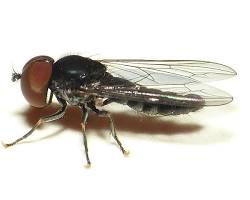
The Big-headed Fly belongs to the insect family Pipunculidae, a fascinating group of parasitic flies recognized for their disproportionately large, rounded heads and oversized compound eyes. Although these insects are small and often overlooked, they play an important ecological role as natural biological control agents for leafhoppers, planthoppers, and other plant-feeding insects. Big-headed flies are commonly found in grassy fields, gardens, agricultural landscapes, woodland edges, and meadows where their host insects are abundant.
Unlike nuisance flies associated with garbage or household infestations, big-headed flies are generally considered beneficial insects. Their larvae develop as internal parasitoids inside leafhoppers and related insects, eventually killing the host. Because many leafhoppers are agricultural pests capable of damaging crops and spreading plant diseases, big-headed flies contribute naturally to ecosystem balance and integrated pest management.
Quick Facts
- Family: Pipunculidae
- Common Name: Big-headed Fly
- Habitat: Fields, meadows, gardens, woodland edges
- Diet: Nectar and honeydew (adults), parasitic larvae feed on leafhoppers
- Status: Beneficial parasitoid insect
- Primary Hosts: Leafhoppers and planthoppers
Identification
Big-headed flies are very small insects, usually measuring between 1/8 and 1/4 inch long. Their most recognizable characteristic is the unusually large rounded head that dominates much of the body.
Key identification features include:
- Extremely large compound eyes
- Rounded oversized head
- Slender dark-colored body
- Clear wings
- Thin legs
- Compact fly-like appearance
The large eyes nearly cover the entire head in many species, giving the insect a distinctive appearance unlike most other flies.
Coloration is usually:
- Black
- Dark brown
- Grayish-black
Adults are fast fliers and can be difficult to observe closely because of their small size and rapid movements.
Distribution and Habitat
Big-headed flies occur throughout North America and are distributed widely across Europe, Asia, and other temperate regions.
They are especially common in habitats that support abundant populations of:
- Leafhoppers
- Planthoppers
- Small plant-feeding insects
Typical habitats include:
- Grasslands
- Meadows
- Gardens
- Agricultural fields
- Forest edges
- Roadside vegetation
- Prairies
- Wetland margins
Adults are often found resting on vegetation or flying low through grassy areas while searching for hosts or nectar sources.
Life Cycle
Big-headed flies undergo complete metamorphosis consisting of:
- Egg
- Larva
- Pupa
- Adult
Their life cycle is highly specialized and closely tied to host insects.
Female flies locate suitable hosts, most commonly leafhoppers, and deposit eggs directly into or onto the host insect.
Once the egg hatches, the larva develops internally inside the host’s body. The larva feeds gradually on internal tissues while allowing the host to remain alive during much of development.
Eventually:
- The host weakens
- The parasitoid larva fully matures
- The host insect dies
- The larva pupates
- An adult fly emerges
This parasitoid behavior helps naturally regulate populations of agricultural plant pests.
Behavior
Adult big-headed flies primarily feed on:
- Nectar
- Honeydew
- Plant sugars
- Moist organic material
They are often active during warm daylight hours and may hover near vegetation while searching for mates or hosts.
Females exhibit highly specialized host-searching behavior and can detect leafhoppers hidden within vegetation.
Their larvae are highly efficient parasitoids and play an important ecological role in controlling plant-feeding insect populations naturally.
Ecological Importance
Big-headed flies are considered highly beneficial insects because they attack species that damage crops and ornamental plants.
Hosts commonly include:
- Leafhoppers
- Planthoppers
- Other sap-feeding true bugs
Many leafhopper species spread serious plant diseases, including:
- Plant viruses
- Phytoplasmas
- Bacterial pathogens
By reducing leafhopper populations, big-headed flies indirectly help:
- Protect crops
- Reduce disease spread
- Support biological pest control
- Improve ecosystem balance
For this reason, they are often welcomed in agricultural and garden ecosystems.
Pest Status
Big-headed flies are not considered pests.
They:
- Do not bite humans
- Do not infest homes
- Do not damage structures
- Do not contaminate food
- Do not damage plants directly
Instead, they are viewed as valuable beneficial insects because of their role in controlling pest insect populations naturally.
Relationship with Agriculture
Researchers and agricultural specialists often study big-headed flies because of their potential value in integrated pest management (IPM) programs.
Leafhoppers are major pests of:
- Grapes
- Vegetables
- Ornamental plants
- Grasses
- Fruit trees
- Field crops
Natural parasitoids like big-headed flies help reduce the need for chemical insecticides and contribute to healthier agricultural ecosystems.
Prevention
No prevention measures are needed for big-headed flies since they are beneficial insects and do not threaten structures or human health.
In fact, many gardeners and farmers encourage beneficial parasitoids by:
- Reducing unnecessary pesticide use
- Maintaining plant diversity
- Providing flowering plants for nectar
- Supporting healthy ecosystems
Control
Control is not recommended.
Because these insects provide valuable biological control services, eliminating them may unintentionally increase populations of harmful plant pests like leafhoppers.
In most cases, big-headed flies should be protected and appreciated as part of a balanced ecosystem.
Interesting Facts
- The family Pipunculidae contains over 1,400 described species worldwide.
- Their enormous eyes provide excellent vision for locating hosts.
- Many species specialize in attacking only certain leafhopper hosts.
- Big-headed flies are among the most specialized parasitoid flies in nature.
- Some species are difficult to identify without microscopic examination.