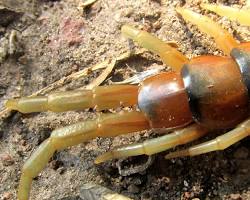
The Bean Leaf Beetle (Cerotoma trifurcata) is a common agricultural pest that primarily feeds on soybeans and other legume crops. This small leaf-feeding beetle is capable of causing significant economic damage when populations become high, particularly in commercial soybean production regions. In residential gardens, bean leaf beetles may also attack snap beans, lima beans, and other garden legumes, creating visible feeding injury on leaves and pods.
Identification
Bean leaf beetles are small oval-shaped beetles that usually measure about 1/4 inch long. Their coloration varies considerably, ranging from pale yellow and tan to reddish-brown or greenish-yellow.
- Small oval body shape
- Yellow, tan, or reddish coloration
- Dark triangular marking behind the thorax
- Black margins along wing covers
- Smooth shiny appearance
Many individuals display black spots on the wing covers, although the number and arrangement of spots vary. One of the most reliable identification features is the small black triangular patch located near the base of the wing covers directly behind the thorax.
Adult feeding damage often appears as small round holes scattered throughout leaves.
Distribution and Habitat
Bean leaf beetles are widely distributed across North America and are especially common in regions where soybeans and legumes are heavily cultivated.
Common habitats include:
- Soybean fields
- Vegetable gardens
- Field edges
- Weedy agricultural areas
- Legume crop systems
- Garden beds with beans or peas
Adults overwinter in protected debris, leaf litter, wooded edges, and grassy vegetation before emerging in spring to locate host plants.
Life Cycle and Behavior
Bean leaf beetles undergo complete metamorphosis with four life stages:
- Egg
- Larva
- Pupa
- Adult
Females lay eggs in the soil near host plants. After hatching, larvae feed underground on roots and root nodules of soybean and bean plants.
Adult beetles feed above ground on:
- Leaves
- Flowers
- Seed pods
- Tender stems
Leaf feeding creates characteristic round holes or “shot-hole” injury. Later in the season, adults may feed directly on soybean pods, increasing the risk of disease and reducing market quality.
Depending on climate conditions, there may be multiple generations each year.
Damage and Economic Importance
Bean leaf beetles are considered important agricultural pests because both larvae and adults damage crops.
Common damage includes:
- Defoliation of soybean leaves
- Reduced plant vigor
- Pod scarring and feeding injury
- Lower crop yield
- Increased disease transmission
In commercial soybean systems, heavy infestations can significantly reduce profitability. Adult feeding on pods may also allow fungal pathogens and secondary infections to enter developing seeds.
The beetles are also associated with spreading certain soybean diseases, increasing their overall agricultural importance.
Pest Status
Bean leaf beetles are classified as significant crop pests in many agricultural regions. Population outbreaks are especially problematic during warm growing seasons with favorable overwintering conditions.
In backyard gardens, infestations are usually smaller but can still damage bean plants and reduce harvest quality.
Prevention
- Rotate crops regularly.
- Remove weeds near garden beds and fields.
- Monitor plants throughout the growing season.
- Encourage beneficial predators and parasitoids.
- Inspect leaves for early feeding injury.
- Maintain healthy vigorous plants.
Early monitoring is especially important because populations can increase rapidly once adults begin reproducing.
Control
Integrated pest management (IPM) strategies are commonly used for bean leaf beetle control.
Management methods include:
- Crop rotation
- Field scouting and monitoring
- Row covers in small gardens
- Targeted insecticide applications
- Removal of nearby host weeds
- Encouraging natural enemies
In commercial agriculture, insecticide applications are typically based on established economic thresholds to minimize unnecessary treatments.
Interesting Facts
- Bean leaf beetles are highly variable in color and markings.
- Adults can survive winter in protected vegetation and debris.
- Soybeans are one of their preferred host plants.
- Pod feeding often becomes more serious late in the growing season.
- The species is one of the most recognized soybean pests in North America.