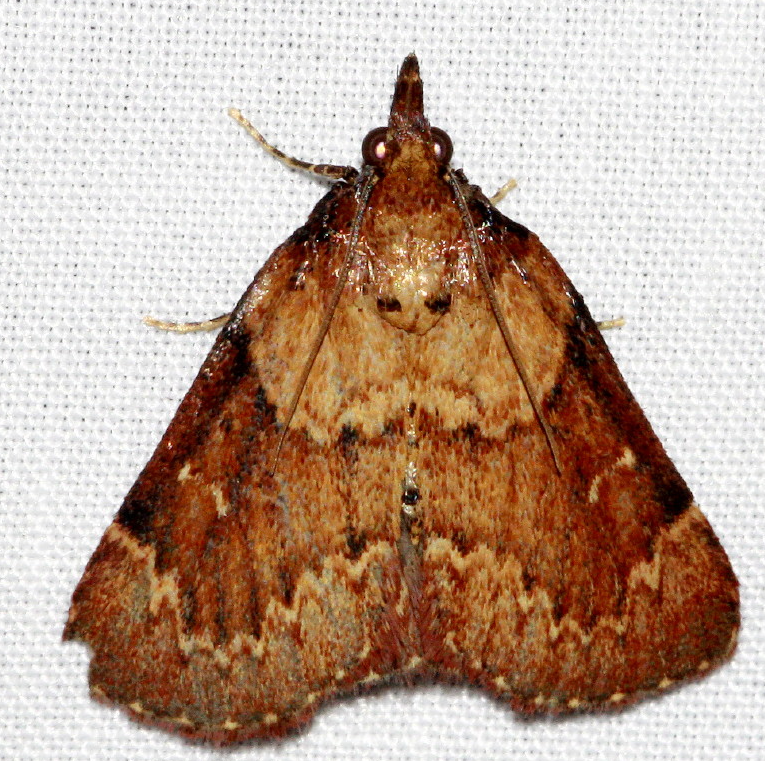
p>Asimina Webworm Moth (Omphalocera munroei) is a species of snout moth in the family Pyralidae, commonly associated with pawpaw trees (Asimina spp.). Native to North America, this insect is primarily found in regions where pawpaw trees grow, including forests, riparian areas, and natural landscapes. The larval stage is known for creating silken webbing on leaves, which can lead to noticeable but typically non-lethal damage.
While the Asimina Webworm Moth can be considered a minor pest of pawpaw trees, it is generally not a significant threat to healthy, established plants.
Taxonomy and Classification
- Common Name: Asimina Webworm Moth
- Scientific Name: Omphalocera munroei
- Order: Lepidoptera
- Family: Pyralidae
- Type: Webworm moth (leaf-feeding insect)
The family Pyralidae includes many species whose larvae create silk webbing and feed on plant material.
Identification and Physical Description
Adult Asimina Webworm Moths are relatively small, with a wingspan typically ranging from 3/4 to 1 inch. They have a slender body and characteristic snout-like mouthparts.
Key identifying features include:
- Gray to brown forewings with subtle patterning
- Narrow wings held close to the body at rest
- Snout-like appearance due to elongated mouthparts
Larvae are more easily observed and are responsible for damage. They are typically:
- Greenish or yellowish caterpillars
- Found within silken webbing on leaves
The webbing is a key sign of infestation.
Life Cycle
The Asimina Webworm Moth undergoes complete metamorphosis, progressing through egg, larva, pupa, and adult stages.
Females lay eggs on the leaves of host plants. After hatching, larvae begin feeding and produce silk to create protective webs.
Larvae feed within these webs, which protect them from predators and environmental conditions.
After completing development, larvae pupate within the webbing or nearby plant material. Adults emerge to reproduce.
There may be one or more generations per year, depending on climate.
Host Plants
The primary host plants for the Asimina Webworm Moth are:
- Pawpaw trees (Asimina spp.)
This specialization limits the insect’s impact to areas where these plants are present.
Damage and Symptoms
Larval feeding results in several characteristic symptoms:
- Silken webbing on leaves
- Skeletonized or chewed foliage
- Clumped or folded leaves
While visually noticeable, damage is usually not severe and rarely threatens the overall health of mature trees.
Habitat and Distribution
The Asimina Webworm Moth is found in regions of North America where pawpaw trees grow, particularly in:
- Deciduous forests
- Riparian zones
- Natural and cultivated landscapes
Its distribution is closely tied to the presence of host plants.
Behavior and Ecology
Larvae feed in groups within webbed leaves, which can make infestations more noticeable. The webbing provides protection from predators and environmental stress.
Adults are nocturnal and are often attracted to light sources. They are typically short-lived and focused on reproduction.
Natural predators, including birds and parasitic insects, help regulate populations.
As part of the ecosystem, the species contributes to food webs and plant-insect interactions.
Management and Control
Management is usually not necessary but may be considered for aesthetic reasons:
- Pruning: Remove and destroy webbed foliage
- Manual removal: Handpick larvae when feasible
- Biological control: Encourage natural predators
Chemical control is rarely needed due to the limited impact of this species.
Prevention
Preventative measures include:
- Regular inspection of pawpaw trees
- Maintaining plant health
- Encouraging biodiversity
Healthy plants are more resilient to minor feeding damage.
Human Interaction and Risks
The Asimina Webworm Moth is harmless to humans. It does not bite or sting and poses no health risks.
Its impact is limited to plant foliage and is generally minor.
Related Articles
Conclusion
The Asimina Webworm Moth is a minor pest associated with pawpaw trees, known for its web-forming larvae. While it can cause visible damage, it rarely threatens plant health.
With minimal management and a focus on plant health, this species can be easily tolerated as part of natural ecosystems.