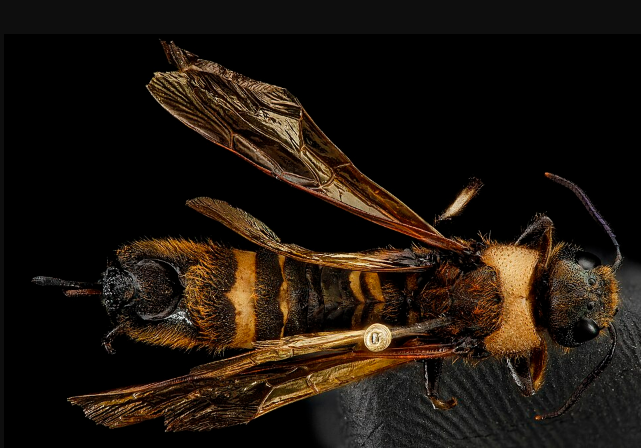
Asian Horntail (Eriotremex formosanus) is a species of wood-boring sawfly in the family Siricidae, commonly known as horntails or wood wasps. Native to Asia, this species has been introduced to parts of North America, where it is associated with hardwood trees. Despite its intimidating appearance, the Asian Horntail is generally considered a secondary pest, primarily attacking weakened, stressed, or recently dead trees.
This species is notable for its long, spear-like ovipositor in females and its association with symbiotic fungi, which assist in the breakdown of wood during larval development.
Taxonomy and Classification
- Common Name: Asian Horntail
- Scientific Name: Eriotremex formosanus
- Order: Hymenoptera
- Family: Siricidae
- Type: Wood-boring sawfly
The family Siricidae includes horntails, which are not true wasps despite their appearance. They are closely related to sawflies and lack the constricted “waist” seen in true wasps.
Identification and Physical Description
The Asian Horntail is a relatively large insect, typically measuring 1 to 1.5 inches in length. Its appearance is often mistaken for that of a large wasp.
Key identifying features include:
- Cylindrical body without a narrow waist
- Dark brown to black coloration, sometimes with lighter markings
- Long, rigid ovipositor in females
- Horn-like projection at the end of the abdomen
Larvae are creamy white, legless grubs that live within wood and are rarely seen unless the tree is cut open.
Life Cycle
The Asian Horntail undergoes complete metamorphosis, progressing through egg, larva, pupa, and adult stages.
Females use their ovipositor to drill into wood and lay eggs, often introducing symbiotic fungi at the same time. These fungi help break down the wood, making it easier for larvae to feed.
Larvae develop within the wood, feeding on fungus-infested tissue. This stage can last several months to over a year, depending on conditions.
Pupation occurs within the wood, and adults emerge by boring exit holes.
Host Trees
The Asian Horntail primarily infests hardwood trees, including:
- Oak
- Maple
- Sweetgum
- Other deciduous species
It typically targets trees that are already stressed, injured, or dying.
Damage and Symptoms
Damage caused by the Asian Horntail is usually associated with its larval stage and includes:
- Internal tunneling within wood
- Exit holes in trunks or branches
- Fungal staining of wood
Because it primarily attacks weakened trees, it is rarely the primary cause of tree decline.
In some cases, infestations may reduce the quality of timber or ornamental value.
Habitat and Distribution
The Asian Horntail is native to Asia but has been introduced to parts of North America. It is commonly found in:
- Forests and woodlands
- Urban and suburban landscapes
- Areas with stressed or damaged trees
Its distribution is closely linked to the availability of suitable host trees.
Behavior and Ecology
Adult Asian Horntails are active during warm months and are often seen flying near trees. Despite their intimidating appearance, they are non-aggressive.
The species plays a role in wood decomposition, particularly through its association with fungi.
Natural predators, including birds and parasitic insects, help regulate populations.
As part of the ecosystem, it contributes to nutrient cycling and forest dynamics.
Human Interaction and Risks
The Asian Horntail is harmless to humans. It does not sting, even though the female’s ovipositor may resemble a stinger.
It poses no direct health risks and is not aggressive.
Management and Control
Management is typically focused on maintaining tree health:
- Remove stressed or dying trees to reduce breeding sites
- Promote tree vigor through proper care
- Monitor for signs of infestation
Chemical control is rarely necessary or effective due to the internal feeding habits of larvae.
Prevention
Preventative measures include:
- Maintaining healthy trees through proper watering and fertilization
- Avoiding mechanical damage to trees
- Removing infested wood promptly
Healthy trees are less susceptible to infestation.
Related Articles
Conclusion
The Asian Horntail is a wood-boring insect that primarily affects weakened or dying trees. While it may contribute to structural damage in wood, it is generally not a serious pest and plays a role in natural decomposition processes.
By maintaining tree health and monitoring for signs of stress, its impact can be minimized while recognizing its ecological role in forest ecosystems.