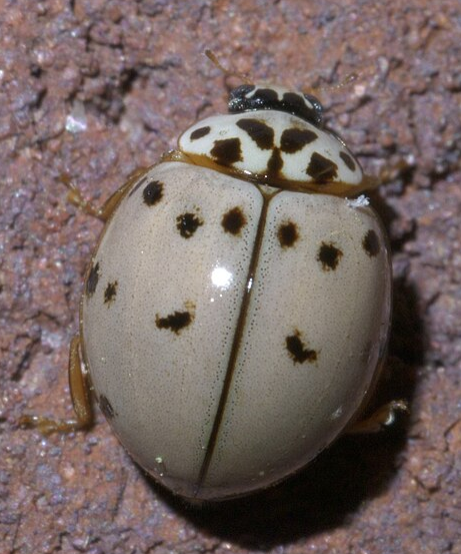
Ashy Gray Lady Beetle (Olla v-nigrum) is a species of lady beetle (ladybug) in the family Coccinellidae. Native to North America, this species is widely distributed and commonly found in gardens, agricultural fields, forests, and urban landscapes. It is highly valued as a beneficial predatory insect due to its role in controlling pest populations such as aphids and scale insects.
The Ashy Gray Lady Beetle is notable for its variable coloration and adaptability to different environments. It is not considered a pest and is an important component of integrated pest management (IPM) systems.
Taxonomy and Classification
- Common Name: Ashy Gray Lady Beetle
- Scientific Name: Olla v-nigrum
- Order: Coleoptera
- Family: Coccinellidae
- Type: Predatory beetle (beneficial insect)
The family Coccinellidae includes many species of lady beetles known for their role in biological control of plant pests.
Identification and Physical Description
The Ashy Gray Lady Beetle is a small beetle, typically measuring 3 to 5 mm in length. It exhibits considerable variation in coloration, which can make identification challenging.
Key identifying features include:
- Two primary color forms:
- Gray or ashy form with small black spots
- Black form with red or orange spots
- Oval, dome-shaped body
- Short antennae
The pronotum (area behind the head) often has a pale background with a distinctive dark marking resembling a “W” or “M” shape.
Larvae are elongated and somewhat alligator-like in appearance, typically dark with lighter markings.
Life Cycle
The Ashy Gray Lady Beetle undergoes complete metamorphosis, progressing through egg, larva, pupa, and adult stages.
Females lay clusters of eggs near colonies of prey such as aphids. After hatching, larvae begin feeding immediately.
The larval stage consists of several instars, during which the insect consumes large numbers of pest insects.
After completing development, the larva pupates on a plant surface. Adults emerge and continue feeding and reproducing.
Multiple generations may occur per year, especially in warmer climates.
Habitat and Distribution
The Ashy Gray Lady Beetle is widely distributed across North America and is commonly found in:
- Gardens and landscaped areas
- Agricultural fields
- Forests and woodlands
- Urban environments
It is highly adaptable and thrives in areas where prey insects are abundant.
Behavior and Ecology
Both larvae and adults are active predators. They feed on a wide range of soft-bodied insects and are often seen on plants infested with aphids.
Adults may aggregate in large numbers, especially when overwintering. In colder months, they often seek shelter in protected areas, including buildings.
This species plays an important role in natural pest control and is frequently encouraged in IPM programs.
Diet
The Ashy Gray Lady Beetle feeds on a variety of pest insects, including:
- Aphids
- Scale insects
- Whiteflies
- Mites
Both larvae and adults consume significant numbers of these pests, making them highly beneficial.
Benefits and Importance
The Ashy Gray Lady Beetle provides numerous ecological and agricultural benefits:
- Natural control of pest insect populations
- Reduction in the need for chemical pesticides
- Support of sustainable agriculture
- Contribution to biodiversity
It is widely recognized as a valuable biological control agent.
Human Interaction and Risks
This species is harmless to humans. It does not bite or sting and poses no health risks.
However, during overwintering, large numbers may enter buildings, where they can become a nuisance.
In such cases, they do not cause structural damage and are best removed gently.
Management and Control
Control is generally not recommended due to the beetle’s beneficial nature. If necessary, nuisance populations can be managed by:
- Sealing entry points in buildings
- Vacuuming individuals without crushing them
- Reducing indoor attractants
Outdoor populations should be preserved for their pest control benefits.
Prevention
Preventative measures for indoor nuisance issues include:
- Sealing cracks and gaps in structures
- Installing screens on windows and vents
- Reducing outdoor lighting that attracts insects
These steps help limit indoor entry without harming the beetles.
Related Articles
Conclusion
The Ashy Gray Lady Beetle is a highly beneficial insect that plays a critical role in controlling pest populations in both natural and managed environments. Its adaptability and voracious appetite for pests make it an important ally in sustainable pest management.
By encouraging its presence and minimizing unnecessary pesticide use, gardeners and farmers can take advantage of its natural pest control capabilities.