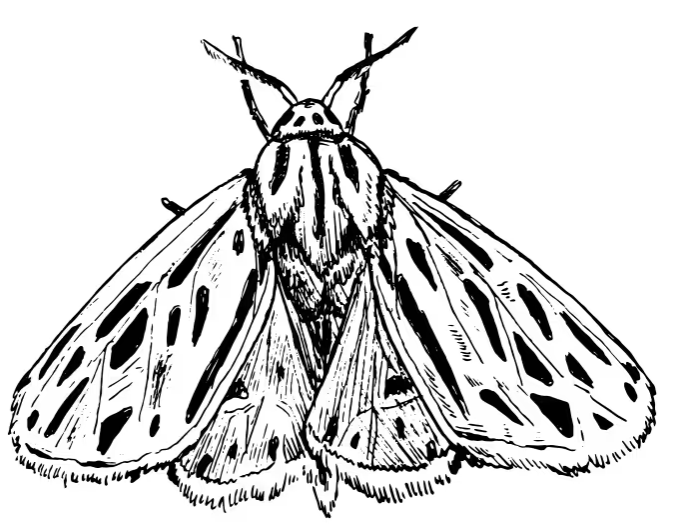
Arge Moth (Arge spp.) is a name sometimes associated with insects in the genus Arge, though technically these are sawflies rather than true moths. Members of this group belong to the order Hymenoptera, making them more closely related to wasps and bees than to butterflies or moths. In North America and Europe, species such as the Large Rose Sawfly (Arge pagana) are among the most commonly encountered representatives.
Despite the occasional confusion in naming, Arge species are best understood as plant-feeding insects whose larvae resemble caterpillars. Some species are considered minor pests, particularly in ornamental plantings.
Taxonomy and Classification
- Common Name: Arge Moth (Sawfly)
- Scientific Group: Arge spp.
- Order: Hymenoptera
- Family: Argidae
- Type: Sawfly (plant-feeding insect)
The family Argidae includes sawflies whose larvae feed on plants and whose adults resemble small wasps.
Identification and Physical Description
Adult Arge species are small to medium-sized insects, typically measuring 6 to 12 mm in length. They resemble wasps more than moths and have:
- Slender bodies
- Dark or metallic coloration, sometimes with orange or yellow markings
- Transparent wings
Larvae are more commonly noticed and resemble caterpillars. They typically have:
- Soft, segmented bodies
- Green, yellow, or black coloration
- Multiple pairs of prolegs (more than true caterpillars)
This similarity to caterpillars often leads to misidentification.
Life Cycle
Arge species undergo complete metamorphosis, progressing through egg, larva, pupa, and adult stages.
Females use a specialized saw-like ovipositor to cut into plant tissue and lay eggs. After hatching, larvae feed on leaves and may occur in groups.
Larvae pass through several instars before dropping to the ground to pupate, often in soil or leaf litter.
Adults emerge to mate and continue the cycle. Multiple generations may occur per year in favorable conditions.
Host Plants
Arge larvae feed on a variety of plants depending on the species. Common host plants include:
- Roses (notably for Arge pagana)
- Shrubs and ornamental plants
- Various deciduous plants
This feeding behavior can bring them into close contact with gardens and landscaped areas.
Damage and Symptoms
Larval feeding can result in visible plant damage, including:
- Skeletonized leaves
- Chewed foliage
- Defoliation in severe infestations
Damage is often localized but can be significant on ornamental plants like roses if populations are high.
Habitat and Distribution
Arge species are widely distributed across North America, Europe, and other regions. They are commonly found in:
- Gardens and landscaped areas
- Woodlands and forest edges
- Fields and shrublands
Their presence is closely tied to the availability of host plants.
Behavior and Ecology
Larvae are the primary feeding stage and may be seen feeding openly on leaves. Some species feed in groups, which can increase the visibility and impact of damage.
Adults are short-lived and primarily focused on reproduction. They may be seen flying around host plants or resting on foliage.
Natural predators, including birds and parasitic wasps, help regulate sawfly populations.
As part of the ecosystem, these insects contribute to food webs and nutrient cycling.
Management and Control
Management may be necessary if infestations are severe, particularly on ornamental plants.
- Manual removal: Handpick larvae from plants
- Pruning: Remove heavily infested foliage
- Biological control: Encourage natural predators
- Insecticides: Use targeted treatments if necessary (note that some caterpillar-specific products may not be effective on sawflies)
Early detection helps reduce damage and limit population growth.
Prevention
Preventative measures can reduce the likelihood of infestations:
- Inspect plants regularly
- Maintain plant health
- Encourage beneficial insects
- Avoid excessive nitrogen fertilization
Healthy plants are more resilient to feeding damage.
Human Interaction and Risks
Arge species are harmless to humans. They do not sting or bite and pose no health risks.
They are primarily of concern due to their potential impact on ornamental plants.
Related Articles
Conclusion
The so-called Arge Moth is more accurately a sawfly, representing an interesting group of plant-feeding insects that are often mistaken for caterpillars. While some species can cause damage to ornamental plants, their impact is usually manageable.
Understanding their life cycle and behavior allows for effective monitoring and control when necessary, while also recognizing their role within broader ecosystems.